

Code of Ethics
Everything you do is governed by your personal morals and values. Anyone can be a breeder, but an ethical breeder takes extra care and effort.
This is our personal code of ethics we follow:
- All ferrets shall be 12 weeks of age before going to their new home.
- All ferrets shall be microchipped and fully vaccinated before going to their new home.
- All ferrets shall be in the best possible health before going to new homes.
- All new owners will be educated on and offered resources on ferret ownership and care.
- No ferret shall be bred in an inappropriate state, such as being underweight, sick or ill, before reaching full maturity, or being 5 years or older for jills or 7 years or older for hobs.
- The breeder shall be reasonably available to new ferret owners to offer advice and answer their questions.
- The breeder will make all efforts to reduce the possibility of unethical backyard breeding with ferrets from their litters, e.g. enforcing a written agreement with all new owners.

So you want to breed ferrets?
There's a lot of things you need to think of before you start. See if you can answer all of these questions first, have backup plans, and even MORE backup plans!
Do you understand and have knowledge of your ferrets' lineages and genetics?
-
Do you know your ferret's genetic pehnotype/genotype? What about their lineage?
-
What are the personalities of their ancestors?
-
Do their parents, grandparents, or great-grandparents show any signs of Waardgenburg or Congenital Sensorineural Deafness?
-
What are their ancestors' typical lifespan?
-
Are their ancestors more prone to seizues, heart problems, insulinoma, or lymphoma?
-
Will pairing your ferrets have a higher risk of these problems? Silver, Lilac, Albino, and DEW shouldn't be paired together, as they have a higher chance of Waardenburg and CSD.
-
Will these ferrets mating lead to potential homozygous lethal outcomes, such as DEW/DEW?
-
Do you understand how genetics work and know what to expect from breeding these ferrets together? What percentage will be black, chocolate, silver, etc.?
Can you emotionally and mentally prepare for and handle worse-case scenarios?
-
Pregnancy is one of the most dangerous experiences a ferret can go through. You must be prepared to potentially lose your jill every time you breed her.
-
Your jill may have pregnancy complications such as pregnancy toxemia, dystocia, placentitis, and dangerous infections. In these cases, you may lose kits and even the jill herself.
-
Some jills may cannibalise their kits. In these cases, you will have to ethically dispatch half-eaten kits to reduce chances of diseases.
-
Some kits may still be alive and half-eaten. You must put them out of their misery yourself. A trip to the vets in the case of imminent death is only prolonging their suffering.
-
Some ferrets may be born with a congenital genetic disorder that reduces their quality of life greatly. In these cases, it is most ethical to have those kits put down.
-
Congenital Spina Bifida may lead to stillbirth or kits being born with death rapidly approaching. In these cases, it is most ethical to have those kits put down.
-
If a litter is infected with a congenital toxoplasma infection, all surviving kits must be tested. Survival of infected kits is extremely low, as treatment is near impossible during the first week post-partum. Survivors are typically stunted in their growth.
-
If you cannot bear the thought of death or putting down a ferret, breeding is not for you.
Why do you want to breed ferrets?
-
You want to make a bit of money? Breeding ferrets is not lucrative and you will often lose money
-
You want another copy of your current ferret? You may lose that ferret
-
You've bred other animals and want to breed ferrets too - ferrets are a lot more difficult to breed than dogs and cats
-
Good goals: improving the breed, promoting responsible ferret ownership
Do you have the finances to commit to this?
-
Can you afford to feed up to 45 times the amount of girls you intend to breed? If you breed one jill, she can have up to 15 kits. Kits eat 2-3 times as much as adults. Can you afford to feed 45x more than what you are currently feeding a single ferret?
-
Can you afford feeding that for at minimum 2 months? Ferret kits start properly eating meat around 1 month old and should stay with their mother until 12 weeks.
-
Can you afford to vaccinate up to 15 kits? Vaccination after 12 weeks is recommended, as this is proven to provide at least 1 year of coverage with one dosage.
-
Can you afford to microchip up to 15 kits? You may also need to pay microchip transfer fees, as most implanters will register a litter to your name and then YOU will need to transfer to their new owner.
-
In case of emergencies, you will need to have thousands of dollars on hand for veterinary bills.
Do you have another breeder or two that you can contact for help/advice?
-
Shadowing/following a breeder for a few breeding seasons is the best method to learn. You can do this by offering to help with cleaning the ferrets in exchange for asking questions/learning about the breeding process.
-
Make sure you maintain a positive relationship with other breeders. Doesn't have to be friendly, but respectful. This is helpful in the case of needing to foster kits.
-
Ask for their ferrets' lineage information so you can learn how their genetics have been passed down and keep track of lineage in preparation for tracking your own.
-
Starting off with only jills is most optimal for a beginner, as they can focus on their girls and ask for a stud hob from a reputable breeder.
-
Having a vasectomised hob is essential, as he can naturally bring jills out of heat when they're too young to breed and helps gets you used to the typical behaviours associated with ferret breeding.
-
Coordinating with other breeders on their breeding schedule/s can be beneficial in case you need to foster kits. If you know Breeder A breeds their jills in the second month of Spring, breeding your jill/s slightly after them is best practice for a beginner.
Are you giving your ferrets the lifestyle required to be a breeding ferret?
-
Ferrets should be on a balanced raw diet. If you cannot provide this for them and are simply feeding your ferrets kibble, they likely won't have enough nutrition to be able to support breeding and nursing their kits. This will very likely end tragically for both jill and kits.
-
Do you have at least 2 suitable separate housing systems available? One must be adequate enough to house up to 16 ferrets, as the largest ferret litter recorded was 15 kits. Adult hobs should not be housed with kits or jills unless they are mating.
-
Do you have a ferret-savvy vet that you can easily access? Do they have all your and your ferrets' details on file already?
Are your ferrets suitable for breeding? Who will the kits go to?
-
What physical traits do your ferrets have that you believe would better improve ferrets as a whole? Is it a unique or impressive body shape or size? Unique coat colour, markings, or texture?
-
Do your ferrets have a suitable personality for the homes you wish for kits to go to? Are they from working-lines or pet-lines? Do they have a strong prey-drive or are they more affectionate/cuddly?
-
Do you have enough people willing to pay to get a ferret with your potential kit traits/personality? Will you be able to find them suitable homes or will potential owners turn towards other alternatives?
Do you have the time available to take on this role?
-
If something happens to the jill, you will have to take over hand-raising the kits. Can you wake up every 3 hours to bottle-feed up to 15 kits?
-
Can you clean their area up to 3 times per day? 15 kits + jill = LOTS of poop and pee.
-
Do you have time to do their washing 2-3 times per week? Depending on how many blankets you have, you will have to wash frequently. Keeping ferrets housed on wire/hard surfaces is never recommended.
-
Do you have the time to interrogate new potential owners, asking about their living situation, past ferret experience, and ensuring they understand proper ferret care?
-
Do you have the time to allow new potential owners to visit your home and meet the parents?
-
Can you spend hours chatting to them via text/on the phone giving them advice/tips?
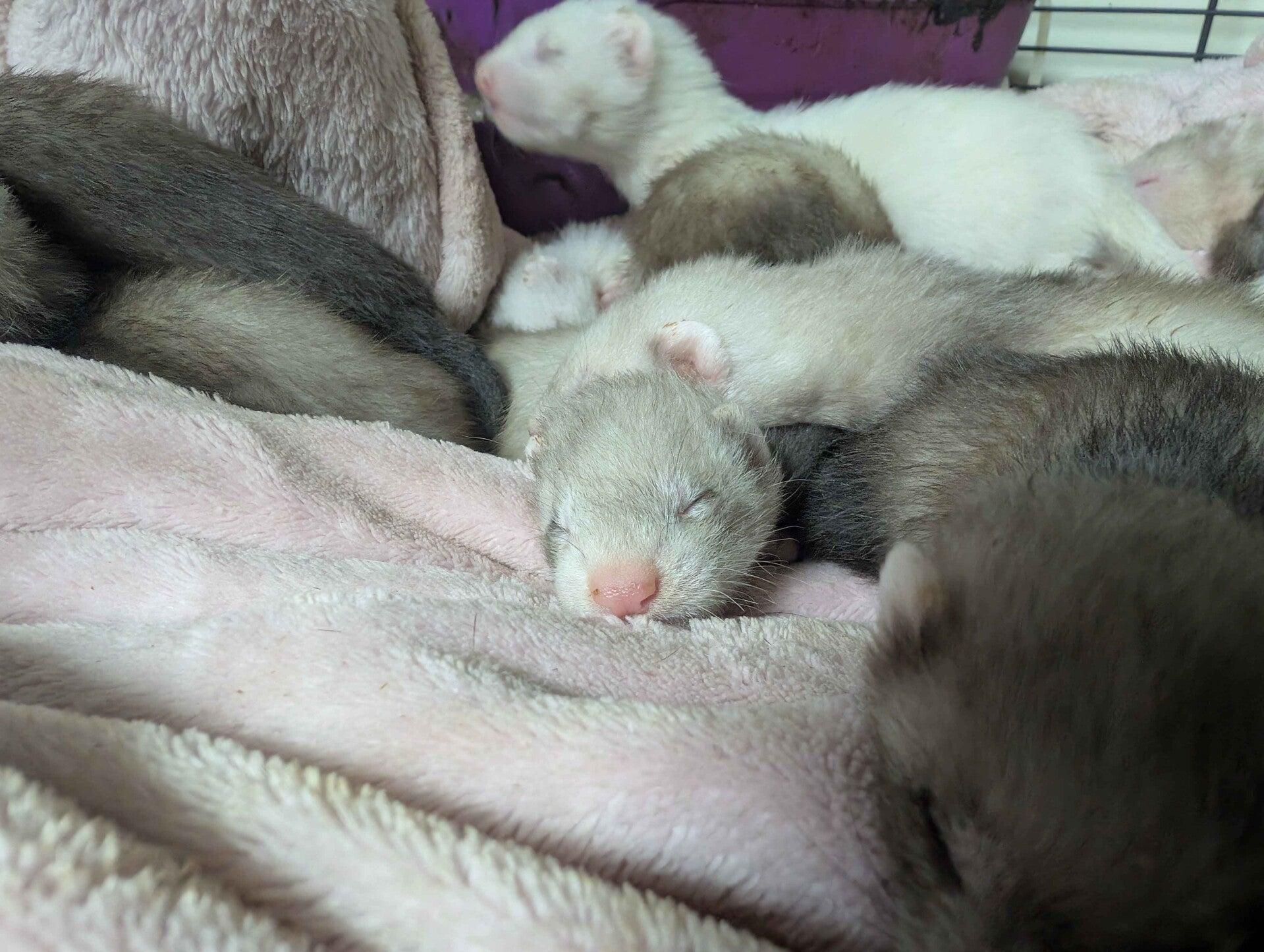
The Dos and Don'ts
You've heard our personal code of ethics, now how about our DON'T list? And we'll even explain WHY we don't want to do them so you understand the reasoning.
- DO NOT breed White to White. This includes: Dark-Eyed Whites, Striped Whites, and Marked Whites. 25% of offspring from these pairings WILL DIE, as the white gene is lethal homozygous, meaning if they inherit 2 pairs, one from each parent, it is always lethal.
- DO NOT breed Albino to Albino. Albinism 'covers' all the genes hidden underneath, meaning the albinos in question could have hidden white genes or piebald genes that can cause congenital defects to the kits or lead to their death.
- DO NOT breed a deaf jill unless you intend to foster ALL of the kits to a hearing jill. Deaf jills struggle to raise kits and are more prone to killing them than hearing jills. It is unethical to intentionally breed her and leave the kits with her, risking the lives and suffering of her kits.
- DO NOT separate a pair of ferrets that are already stuck together in mating. The hob's penis is a peculiar J-shape which causes them to 'lock' together during mating, so pulling them apart can cause physical (and mental) trauma to both ferrets.
- DO NOT keep a jill in heat for longer than 3 weeks. A jill in heat produces high levels of oestrogen, which has a negative impact on their bone marrow. Bone marrow produces blood cells. Less blood cells causes aplastic anemia which can become lethal. Around 50% of jills left in heat will develop this, and left untreated, they can die within 2 months.
- AVOID mixing litters together before you can identify/mark the kits. Tracking lineages is important to figure out the 'source' of certain genetic traits, and if you mixed 2 litters together and kept breeding from the offspring without knowing who the parents are, that is only asking for trouble and potential inbreeding.
- AVOID breeding mitted, blaze, panda, albino, silver, and white ferrets to each other. These white markings are at a higher risk of congenital sensorineural deafness(CSD, deaf from birth), and Waardenburg Syndrome.
Create Your Own Website With Webador